Deposits in the “Bank of Thanks” compound more than we think. The interest paid on gratitude astounds. So counting blessings is worthwhile and giving God the praise. That’s how we prove God’s faithfulness abounds.
Acknowledging how blessed we are assumes humility. For we are not deserving of God’s grace. Our gratitude is based upon a “wealth” we have not earned and recognizing what we’re called to face.
Confessing wrongs that mark our past, we seek to do what’s right by tearing down old walls that can divide. We build new bridges that connect our isolated lives and feast with friends (both old and new) while swallowing our pride.
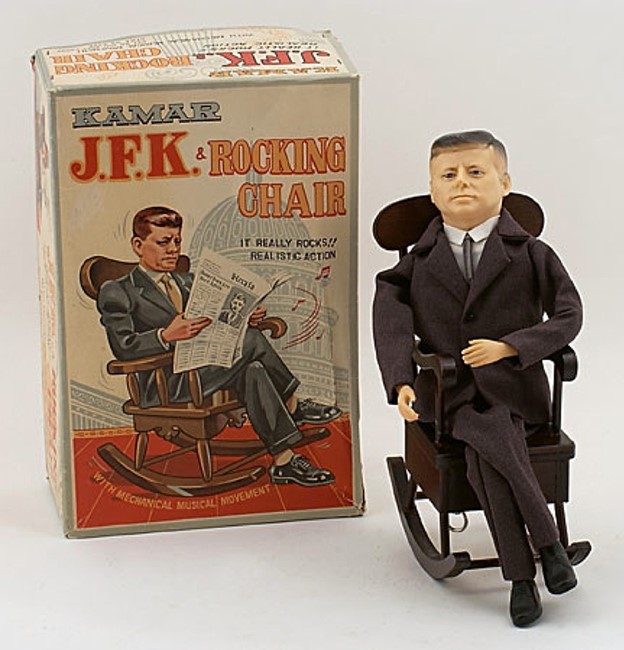
This is the doll Greg’s mother bought him the day JFK was assassinated
On November 22, 1963 I was a sixth grader in room 19 at Liberty Elementary School in Marysville. It was my favorite grade of elementary school. That was mostly the case because Mr. Thacker was the first male teacher I’d had. Because he was a man and because he was only about 16 years older than I was, I related to him very well.
I can’t recall what Mr. Thacker was teaching about that morning, but I do remember that I had a case of the hiccups. I walked to the back of the classroom to get a drink of water. It was while I was stooping to reach the water fountain attached to the sink that the voice of our principal came over the intercom. Miss Ebert informed us that President Kennedy was dead. Within the hour classes were dismissed and we were sent home.
That Friday afternoon began the longest weekend in my memory to that point. Regular television programming was interrupted by somber music. Everything appeared to be happening around me in slow motion. For an eleven-year-old, it was surreal.
Since my pastor-father was out of town on a speaking assignment, my mom took us out to a fast-food restaurant. Afterwards we stopped at a variety store. I begged her to be able to buy a JFK doll that I’d seen before. The twelve-inch figure was seated in a wooden rocking chair. When you wound the key beneath the chair (much like the key to a music box) the chair would rock back and forth playing “Happy Days are Here Again.” In spite of my young age, I knew it would be a collectable item someday. But even more than that, it was a keepsake of someone I greatly admired. I loved President Kennedy even more than I loved Mr. Thacker (and I liked him a lot). Let me explain.
When John Kennedy was running for President in 1960, I celebrated my eighth birthday. One of the gifts I’d requested was a paperback book that I’d seen at our local grocery story. I was impressed with JFK’s good looks. He was young. I was impressed by his sense of humor and his strong Bostonian accent. Since my folks were diehard Republicans, they weren’t inclined to honor my wishes. But when my birthday rolled around, I was delighted to receive what I’d asked for.
After Kennedy was elected and began holding press conferences, I watched on our black and white TV set. I would often stand in front of the bathroom mirror and pretend I was the President talking to the media. I practiced talking like him. My version of “Ask not what your country can do for you…” sounded very much like him. When I would visit my dad at his church office after school, I stood at the pulpit impersonating my hero with an adlib speech.
So Kennedy’s sudden unexpected death impacted me greatly. I was stunned. The day after he was killed, I designed a make-shift protest sign (JFK Why?) and taped it to my blue Schwinn bicycle. I pedaled up and down 3rd street expressing my anger and sorrow.
On Sunday morning I dressed for church. While my brother and I waited for our mom to get ready, we watched the television set in the family room. Since there was no regular programming, what we saw was live coverage of the suspected assassin of President Kennedy being transferred from the Dallas police station. As we watched, we saw Jack Ruby shoot Lee Harvey Oswald in front of the attending officers and reporters covering the scene. It was unreal. Later, after returning from church, we learned Oswald had died from his injuries.
Losing a childhood hero as an eleven-year-old kid opened my eyes to the fact that evil inhabits our world and that things happen all around us all the time that change the course of history. The killing of a beloved President would be the first of other assassinations of public figures within the next half dozen years. I realized life is precious and even the most powerful are not immune from tragedy. It is a life lesson that I continue to embrace as a seventy-one-year-old.
When a friend turned fifty sometime back, I wrote this humorous rhyme:
You’ve reached the age where once again you play at hide and seek. Your playmates aren’t the kids next door, but facts you try to speak. So much of what you once recalled gets stuck inside your mind. Like popcorn hulls between your teeth, some thought get caught you find. But gratefully it’s just a stage. It’s not a total loss. You’ll do just fine if you can find a string of mental floss.
But truth be told loss of memory is no laughing matter. In my ten years as a chaplain at a retirement community, I observed the downside of aging. Growing older comes with the inevitable losses associated with the increased number of candles on our birthday cake. There is the loss of energy. There is the loss of strength and dexterity. There is the loss of hearing. Sadly, there can be the loss of a mate. And, too often, there can also be the loss of memory.
In addition to shepherding individuals in our memory care facility during the final months of their lives, I experienced the challenges of memory loss on a personal level. I watched my own mother navigate the confusing maze of Alzheimer’s Disease over the course of a decade. Gratefully, my little mom never lost her ability to express love to her family or acknowledge her gratitude to God. And she never forgot how to play the piano. She was playing hymns on the baby grand in her care facility up until a couple weeks before she died.
Dementia is an unkind companion of too many people we love. The cost it exacts far exceeds what families pay out for residential care. And yet I’ve come to see that it’s not just the elderly who exhibit memory loss. As a man of the cloth, I have witnessed in my forty-five years of ministry the frequency with which people of faith forget the faithfulness of God. I call it spiritual dementia.
Spiritual dementia is the tendency we have as humans to lose sight of times in our lives when prayers have been answered. We tend to forget how God’s presence sustained us in the midst of heartache or hardship. Having learned lessons of trust through trials and challenges, it is so easy to lose sight of how God came through in the past. The Old Testament is filled with examples of the Children of Israel not remembering what they had once known. And the tendency of God’s people to forget milestones of deliverance and provisions resulted in a lack of gratitude and an abundance of problems.
Remembering is the key. Long before my mom dealt with the demons of memory loss, she taught my brother and me the correlation between memory and gratitude. As little boys we heard our mom repeatedly remind us to “remember to say thanks” whenever we were invited to family friends for dinner. But her reminder to polite extends far beyond having good manners. “Remember to say thanks” is the two-step dance that enables us to recognize just how wealthy we really are. Being grateful is the by-product of looking back at our blessings. No wonder I have never forgotten my mom’s refrain. As this season of Thanksgiving approaches, I find myself focused on the importance of remembering. In our family we take time between the main meal and dessert to go around the table and verbalize those things for which we are thankful. Generalities are not permitted. Specifics are what is expected. And specifics are not all that hard to come up with if time has been spent reflecting on the goodness of God over the past year.
The author of Psalm 107 knows the correlation between memory and gratitude. Note how he begins his instructions: “Give thanks to the Lord, for he is good; his love endures forever. Let the redeemed of the Lord tell their stories…”
So what’s your story? Looking back and reviewing the goodness of the Lord will remind you that gratitude is not a mindless exercise. It takes focus and concentration. It takes remembering. Memory is the key!
These are some of the Barbie dolls Greg A’s granddaughters play with
When the Barbie movie was released, I suggested to my wife that we go. And to those who know me, it should come as no surprise that I suggested we go wearing pink. Yes, I have a couple pink shirts in my closet. Sadly, the film had left the theaters before our schedules would allow us to see Ryan Gosling and Margot Robbie on the big screen. Wendy and I donned our pink attire as we watched the blockbuster hit On-Demand on our tv in the family room.
Come to think of it, watching from our family room was the perfect venue to view a fun film that triggered many memories. From the time I was a young dad I played Barbies with my three daughters in our family room. Unlike many of my fellow fathers, I had no problem sitting cross-legged on the floor giving voices to the miniature Mattel misses. I was secure enough in my masculinity to let my hair down while brushing Barbie’s with my girls. In fact, it was in that unique context that I learned a few lessons that have served me well as a pastor. Consider the following:
Trust is more easily earned while meeting another on their level. My daughters LOVED the fact that I was willing to play Barbies with them. It became OUR THING. Stooping to where they were won their hearts. When I was a rookie minister, I observed an older colleague greeting his flock at the door of the church following the service. Rather than patting a child on the head, this pastor took a knee and greeted the little lamb while looking them in the eye. What I saw deeply impressed me. I made it a habit to do the same. But I also discovered the concept of finding common ground holds true with adults as well. When we seek to find common ground with another person, we are more likely to engage them without pretense.
Using one’s imagination cultivates a sense of wonder. Pretending with my girls and creating conversations between the dolls stretched my ability to think outside the box. It gave me a platform for sharing life lessons with my offspring using foot-long plastic figures as a vehicle. It’s amazing how much you can communicate when you are indirectly speaking.
As I look at the New Testament, I see that Jesus did the same. By sharing parables, he invited his listeners to use their imaginations. Through the use of fiction, Jesus fleshed-out truth. And I have found much freedom illustrating bottom-line convictions by sharing hypothetical anecdotes off-the-top of my head.
We are never too old to play. When I first started to dress Ken and Barbie dolls, I was in my early thirties. Now that I am seventy-one, I still find myself on the floor in the family room with my two granddaughters. Just the other day while browsing at the local thrift store, I found a toy sports car with a couple dolls strapped in the front seat. Of course, I bought it for Immy and Ivy. I can imagine hours of play with my pintsize playmates. After all, I have experience making believe.
But the family room floor isn’t the only place we have fun together. There’s the backyard where we play hide-and-seek. There’s the street in front of our house where we roll tennis balls down a hill. And there’s the park next to the thrift store where we use our imaginations and energy. And when it comes to the latter, they have three-times as much as I do.
But even so, play rejuvenates us. It provides a needed distraction from daily routines that serves to reboot our “personal” computers. Play is God’s way to remind us that when all is said and done, we are His children no matter how many candles will adorn our birthday cake this year.



 My Rhymes and Reasons