I took this photo of the Tomb of the Unknown Solider in September 2019
It’s a day to pause and ponder grave reminders that call to mind those who lost their lives that our freedom might be found.
Monuments that speak of sacrifice (both large and small) help us to recall the currency of loyalty used to purchase that which we too often take for granted.
And so today we honor the memory of those who shed their blood while waging war to win our peace.
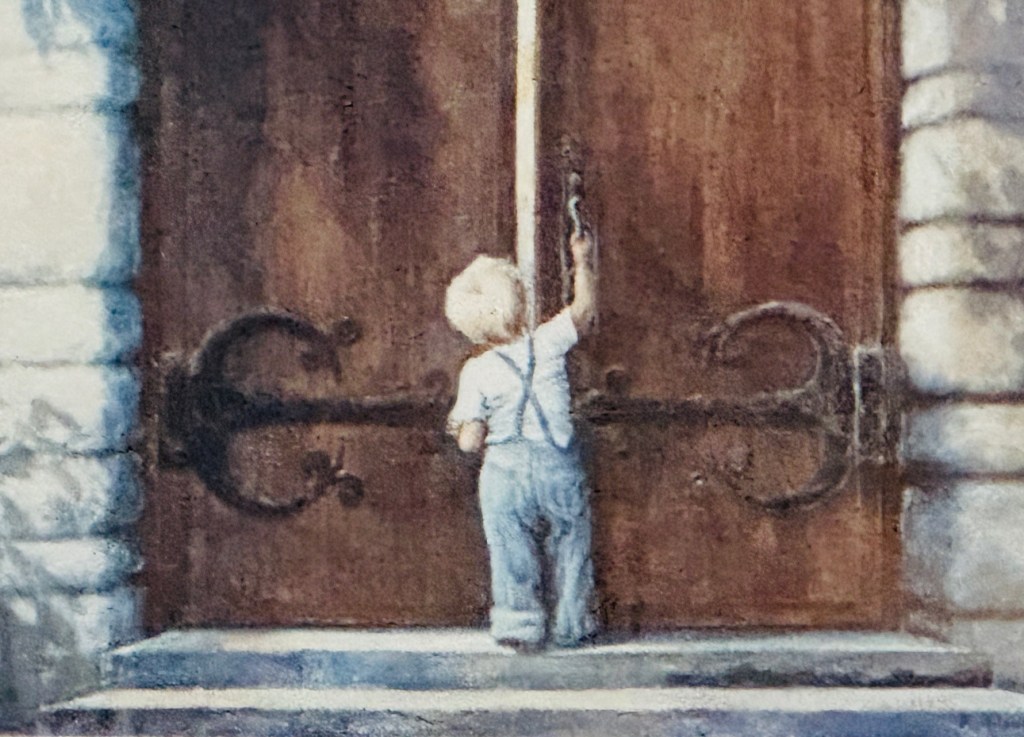
Randy Klassen’s painting “To Such Belongs the Kingdom of God”
A painter with words, an artist with paint, The Reverend Randy Klassen brought truth to life.
He transformed an easel into a pulpit by dipping his brush into the colors of God’s grace.
In the process, he conveyed the beauty of the Father’s love for which His children instinctively hope.
Randy’s “Child at the Church Door” has hung above my desk for forty years. It captured my sense of wonder when, as a young pastor, I stood at the threshold of mystery Sunday after Sunday where earth and Heaven meet.
That child was me. Opening that door was my sacred honor. The image bearer who reminded me of my call was my friend Randy.
Viking Leif Erikson scans the Seattle waterfront in search of an approaching storm
Whether the weather is cold or it’s warm, whether there’s sunshine or threats of a storm, whether dark clouds or blue skies are the norm, weather cannot be our god.
Whether you’re living with hope or with fear, whether your vision is blurry or clear, whether your kids prompt a smile or a tear, you cannot do life on your own.
Whether your passion is work or it’s play, whether the future seems sunny or gray, whether the world is all wrong or okay, you cannot but choose how you’ll live.
*This poem is based on a poem my Norwegian cousin Bjarne Birkeland shared with me in Norway in 2001.
“Whether the weather is cold or whether the weather is hot we’ll weather the weather whatever the weather whether we like it or not.”
I’m thinking of my Norwegian family today. After all, today is May 17th (Syttende Mai) Norwegian Constitution Day.
The Wounded Lion Monument is one of the most popular attractions in Lucerne, Switzerland
This weekend Orthodox Christians around the world are celebrating the resurrection of Jesus. Because the Orthodox Church bases its observance of Easter on the ancient Julian calendar (in contrast to the Gregorian calendar followed by Western Christians), the most holy day of Christendom is celebrated on different days. Typically, the two Easters are a week apart. This year there is more than a month separating the two observances.
As a Protestant pastor with Greek ancestral roots, I have historically celebrated both the traditional Easter with my congregations and the Orthodox Easter with my family. When I was a young boy, my dad taught me the Greek Easter greeting. And to this day our family greets one another with “Christos anesti! Alithos anesti!”
This year finds me celebrating both Western and Orthodox Easter in Lucerne, Switzerland. And for both occasions there is the perfect spot in town at which to sit and contemplate the cornerstone of the Christian faith.
If you have ever visited Lucerne, you likely have stopped at the Wounded Lion Monument. This amazing rock sculpture, designed by famed Danish artist Bertel Thorvaldsen, commemorates the 760 members of the Swiss Guard who lost their lives protecting the King of France during the French Revolution in 1792. The monumental effort to carve the gigantic lion in the side of a sandstone cliff began in 1819 and was completed two years later.
The lion, who measures 20 feet high and is 33 feet long, lies with a broken spear in his back and his head bowed. He is obviously dying. Mark Twain called it “the most moving and mournful piece of stone in the world.”
I first saw the Lucerne Lion in-person six weeks ago while approaching Holy Week. As I stared at the beautiful (yet haunting) work of art, I couldn’t help but think of the Christ-like figure in the first of C. S. Lewis’ Chronicles of Narnia.
In “The Lion, the Witch and the Wardrobe,” the first of Lewis’ chronicles, Aslan the lion willingly lays down his life to lift the curse that has held the Kingdom of Narnia captive. The lion’s lifeless body lies cold and still on a giant stone table.
Using his palette of language, C. S. Lewis paints an unforgettable picture that conjures up the events of Good Friday. This gifted wordsmith conveys the suffering that provides the backdrop for the glorious message of the resurrection.
In his book as the symbolic story unfolds, Lewis pictures Easter Sunday as well. The stone table is discovered by the children without any sign of Aslan. They soon encounter the lion fully alive. Aslan has returned from the dead. The children also realize that Narnia has returned to its original glory.
The land that had been labeled “as always winter but never Christmas” was once again blooming in springtime glory. The visible and invisible evidence of Immanuel (God-with-us) provided Narnia with proof of a redeemed kingdom.
Although I have long believed that the truth of Easter is an ongoing reality and not simply a single day on the liturgical calendar, this year it is all the more in focus. With the two Easter observances of the Christian Church being more than a month apart, there is cause to contemplate the fact the resurrection can be celebrated continuously.
If you’re like me, hardly a week goes by without learning of someone you know (or know of) who has passed away. Death dominates the landscape of our lives. The shadow of sorrow creeps across our hopes and dreams. Grief is an ever-present reality. Parents die. Spouses receive a terminal diagnosis. Siblings leave us prematurely. Even our children are not exempt.
And given the grim reality of the Grim Reaper’s unsolicited visits to our families, knowing that death has been defeated once and for all is something I can’t celebrate enough. Having two Easters is just fine. In fact, I would welcome even a few more. Christ is risen! He is risen indeed!



 My Rhymes and Reasons