The Lyrics of Gratitude

One of the most popular Thanksgiving hymns is Come Ye Thankful People Come

“Over the river and through the woods to grandmother’s house we go…”

That timeless children’s song celebrates Lydia Maria Child’s childhood memories of visiting her grandfather’s house. Curiously, the original version refers to grandfather’s house (not grandmother’s).

Although the Christmas season is replete with carols and holiday songs, “Over the River” was the only Thanksgiving song I remember singing in school. Fortunately, there were songs that we sang in church that compensated for what was lacking in the classroom.

I love Thanksgiving hymns like “Come We Thankful People Come,” “We Gather Together to Ask the Lord’s Blessing” and “For the Beauty of the Earth.” There is just something about the lyrics to songs like “Now Thank We All Our God” and “All Creatures of Our God and King” that tune our hearts to sing God’s praise.

For me Thanksgiving is defined by feasting on turkey and all the trimmings including Gulliver’s creamed corn (a traditional family favorite) and my wife’s homemade pumpkin pie. It also includes the sharing of personal expressions of gratitude around the table before enjoying football.

All the same no Thanksgiving would be complete without borrowing language from folks like Martin Rinkart, Folliott Pierpoint, Fanny Crosby, Johnson Oatman and St. Francis of Assisi in order to voice my gratitude to God.  The hymns of thanks we sing in church on the Sunday not only call us to worship, they remind us what Thanksgiving is all about.

Forty-five years ago, when I became a pastor in a denomination with Scandinavian roots, I discovered a Thanksgiving hymn I’d not sung in my youth. The melody was quite enchanting, but the words were what captured my heart. They were refreshingly candid. They spoke of pain and problems in the midst of a life of filled with blessings. Rather than ignoring hardship and heartache, the poet acknowledge suffering as part of the human experience.

Two of the stanzas read as follows…

Thanks for prayers that Thou hast answered. Thanks for what Thou dost deny!
Thanks for storms that I have weathered. Thanks for all Thou dost supply!
Thanks for pain, and thanks for pleasure. Thanks for comfort in despair!
Thanks for grace that none can measure. Thanks for love beyond compare!

Thanks for roses by the wayside. Thanks for thorns their stems contain!
Thanks for home and thanks for fireside. Thanks for hope, that sweet refrain!
Thanks for joy and thanks for sorrow. Thanks for heav’nly peace with Thee!
Thanks for hope in the tomorrow. Thanks through all eternity!

Upon doing a little research I learned that “Thanks to God for My Redeemer” (“Tack O Gud”) was originally published in Swedish in 1891. It was written by August Storm, a member of the Stockholm Salvation Army.

In addition, I discovered there was a logical reason why the poet referenced life’s setbacks and disappointments in his hymn of thanksgiving. August Storm’s life, like his name suggests, was beset by the unexpected and undesired just like a late summer deluge. Tragically, he suffered a serious back injury that left him crippled for much of his adulthood. Having experienced suffering and pain as a person of faith, he incorporated these realities in his hymn text.

The hymn was introduced to the American church through Swedish immigrants settled in the States near the turn of the twentieth century. As they experienced the hardships of adjusting to a new country, they clung to songs of their faith and heritage. Especially words that recognized problems as part of the faith journey.

As I come to this Thanksgiving week, I find myself counting my blessings. I am grateful for hymns that help me vocalize my gratitude to God for His goodness. But I am also grateful for challenges life deals me that help me see the faithfulness of God more clearly. And with that in mind, I’m grateful for the words written a long time ago by a man I never met.


In addition to each week’s post on this website, Greg Asimakoupoulos offers daily video devotionals on his YouTube channel. Here is a sample video. If you are interested in receiving these devotionals Monday through Friday, you can subscribe on Greg’s channel.
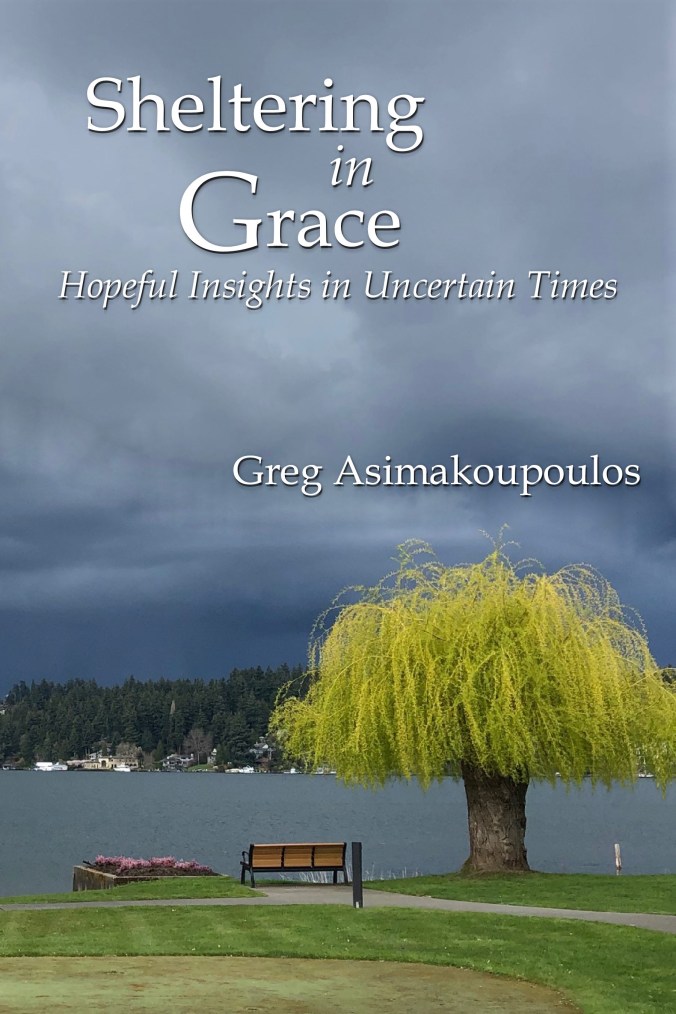
Sheltering in Grace

This book by Greg Asimakoupoulos is available from Lulu.com

When a crisis or virus
might cause us to fear,
we are called to abide and be still.
So, we focus our faith
on the Lord’s promises,
and are freed from the dread
that we feel.

Abiding in Christ
means to “shelter in grace.”
It’s the key to remaining alive.
When we make Christ our home
and take root in His love,
we do more than just live.
We will thrive!

 Remain in me, as I also remain in you. No branch can bear fruit by itself; it must remain in the vine. Neither can you bear fruit unless you remain in me.  “I am the vine; you are the branches. If you remain in me and I in you, you will bear much fruit; apart from me you can do nothing. (John 15:4-5)


In addition to each week’s post on this website, Greg Asimakoupoulos offers daily video devotionals on his YouTube channel. Here is a sample video. If you are interested in receiving these devotionals Monday through Friday, you can subscribe on Greg’s channel.


From Heartache to a Timeless Hymn

The storms of life have birthed many beloved hymns

From heartache to a timeless hymn,
from agony to praise,
the pain of sorrow fills the poet’s pen.
Both It Is Well and Day by Day
were birthed in tragedy
as was the treasured lyric What a Friend.

Amazing Grace came from the depths
of Captain Newton’s heart
that once had been enslaved by hate and greed.
And Andrae Crouch’s Through it All
was rooted in despair
as he cried out to God and voiced his need.

Ironically, so many hymns
that draw us near to God
began as wordless groans and whispered sighs.
And yet songwriters filled with faith
and singed by suffering’s flame
have given us God’s truth both sweet and wise.


In addition to each week’s post on this website, Greg Asimakoupoulos offers daily video devotionals on his YouTube channel. Here is a sample video. If you are interested in receiving these devotionals Monday through Friday, you can subscribe on Greg’s channel.

Your House versus the White House

The street sign outside of the White House

Am I the only one who approaches this month of giving thanks grateful that the campaign season is over? I’m guessing not. The multitude of ads has been maddening. The content of the candidates’ commercials has been controversial. The name calling and character attacks has been juvenile. Regardless of what network you choose for your daily diet of news, what’s been served up the past several months has been anything but nourishing. In spite of the outcome of this week’s election, our United States of America will be anything but.

I am reminded of the words of a first century carpenter-turned-rabbi who said, “A house divided against itself cannot stand.” Although Abraham Lincoln used that famous line in one of his memorable campaign speeches, it was Jesus of Nazareth who coined the expression. What is true for a family or a congregation of the faithful is also true for a nation. A nation divided is terminally ill.

As I reflect on Jesus’ teaching and values, I’m convinced that the antidote to alienation is understanding, forgiveness and compassion. Divisions are healed as we love our neighbors to the degree we love ourselves and to the degree we treat them the way we desire to be treated. How we engage or distance ourselves from those who see life differently than we do has lasting ramifications. Our ongoing attitude and actions toward our political rivals will impact us as well as them. Active animosity can poison the well of friendship within a family, in a faith community or in a work environment.

In her bestselling book “A Team of Rivals” presidential biographer Doris Kearns Goodwin chronicles how Abraham Lincoln chose men who had run against him in his 1860 campaign to serve in his cabinet. The book focuses on our sixteenth president’s mostly successful attempts to reconcile conflicting personalities and political factions on the path to abolition and victory in the American Civil War.

Acknowledging conflict and conflicting views rather than ignoring them, Lincoln proactively engaged the divisions and challenges he faced. He recognized to what degree cooperation depended on him and then made choices accordingly. Our country’s most popular president was no doubt familiar what Saint Paul wrote to the first century Christians in Rome: If it is possible, as far as it depends on you, live at peace with everyone. (Romans 12:18)

As a man of the cloth who resists addressing political issues from the pulpit, I have come to the conclusion that the results of this year’s election will not thwart the sovereign plan of the Almighty. And in the broad scheme of human history, the individual the Electoral College will select will not matter as much as we might think. A look back at presidents over nearly two-hundred-and-fifty years will bear that out.

Granted, the person who will inhabit the White House for the next four years may or may not be the person whose candidacy you supported. The fact that they will lead from that residence is obviously significant. That person will influence the future direction of our republic. Their personal values and worldview will determine what is prioritized and what is put on the back burner.

All the same it is my personal belief that the person who is about to move into the White House matters less than the individuals who currently live in your house. Our nation’s future ultimately depends on the character qualities being shaped and practiced by you and your family in your neighborhood and in your community. Who you are, how you think, what you say, how you act and how you react will have a far more lasting impact on our nation than the temporary inhabitants of 1600 Pennsylvania Avenue.

You matter more than you may think. As we have been reminded in recent weeks, your vote matters. It is your voice in a democratic republic. But even after all the votes have been tabulated, the fabric of your friendship, faith and compassion is what clothes the future of the nation we love regardless of who is our president.

Everyday is Like Sunday!

This is the day the Lord has made. Let us rejoice! Psalm 118:24

Come Sunday we will sing God’s praise
with old hymns sung in newer ways.
But truth be told there are more days
than one that’s called the Lord’s.

He claims them all and we should too.
Each day God speaks to me and you.
And in the psalms, we find a clue
that calls us to rejoice!

This is the day the Lord has made…
And though our feelings, glow and fade,
we lift our voices unafraid
and worship here and now!


In addition to each week’s post on this website, Greg Asimakoupoulos offers daily video devotionals on his YouTube channel. Here is a sample video. If you are interested in receiving these devotionals Monday through Friday, you can subscribe on Greg’s channel.