Within a few days our twelve weeks in Switzerland will come to an end. And once again I have been reminded how quickly time passes. As St. James informs us in his letter in the New Testament, “Life is a vapor.” Or as the Steve Miller Band puts it, “Time keeps on slippin’ into the future.”
At any rate, our time here in the land of Heidi, chocolate and watches wasn’t long enough to learn many words in Swiss German (the dialect spoken in Luzern). By their own admission, those who live here say Schweizerdeutschis quite different from high German. It’s quite difficult to master.
I was grateful that the International Church of Luzern was an English-speaking congregation. But Wendy and I did learn how to say hello in Swiss German. When we arrived at our apartment in the middle of March, we were greeted by a white sign with red letters on a shelf in the entry way. Attempting to sound out grüezi, I asked how to say this seemingly unpronounceable word. I also asked what it meant.
“It’s pronounced GRIT-see,” the chair of the pastoral search committee explained. “It’s how we greet one another. And it’s not all that difficult to say.”
Almost immediately Wendy and I began saying grüezi as we’d meet people in the store and on the street. To our delight strangers greeted us with grüezi in return. We said grüezi often as we took time to visit in the homes of our Swiss congregation. We’d say grüezi as we took day trips on the lake or to the mountains with the members. We’d say grüezi as we’d study the Bible together in small groups.
Learning to say hello to this church family has been deeply rewarding. As the interim minister I was able to give myself fully to loving the flock without being burdened with the demands normally associated with a full-time call. It’s the kind of assignment I’ve come to appreciate.
I’ve served in the role of interim pastor twice in my forty-five years in ministry. Both situations were most fulfilling. In each case, I was tasked with the challenge of holding the congregation together while they anticipated their next fulltime shepherd.
But one of the hard parts of being an interim pastor is making new friendships and investing in relationships only to have to say goodbye a short time later. If you’re wired the way I am, you don’t hold people at arm’s length in order to avoid the pain that goes with farewells. Pastors like me can’t help drawing close to those around you and making memories together. It’s just what we do. But then comes the grief. Or as Shakespeare put it, “Parting is such sweet sorrow.”
I first learned the emotional letdown of saying goodbye to new friends while working my way through seminary. My summer job for three years found me escorting tour groups to Alaska and through the Canadian Rockies. Over a two-week period, I’d get to know my passengers in a very personal way. In a relatively short period of time, we’d share family history and hopes for our future while experiencing memorable moments together that will last a lifetime.
And then I would be forced to say goodbye to new friends. I went into a bit of a depression. The grief was real. The sadness was palatable. But in retrospect, I would call it good grief. I was grieving because I had experienced genuine joy and meaningful friendship before having to say goodbye.
As I come to the end of this Swiss ministry adventure, I’m once again experiencing good grief. The pain is real but so are the connections that Wendy and I have made. Friendships have been born that will be lasting. Relationships have been established that were mutually beneficial. Learning how to say hi in the language of the locals came with a windfall in spite of the tears. But I’m not sorry for the sorrow.
It’s inevitable. Hellos always give way to goodbyes. The present eventually becomes the past. The door of opportunity swings open and shut. But in it all, learning to say grüezi (in any language) is the key that unlocks the doors God places in our path.
I took this photo of the Tomb of the Unknown Solider in September 2019
It’s a day to pause and ponder grave reminders that call to mind those who lost their lives that our freedom might be found.
Monuments that speak of sacrifice (both large and small) help us to recall the currency of loyalty used to purchase that which we too often take for granted.
And so today we honor the memory of those who shed their blood while waging war to win our peace.
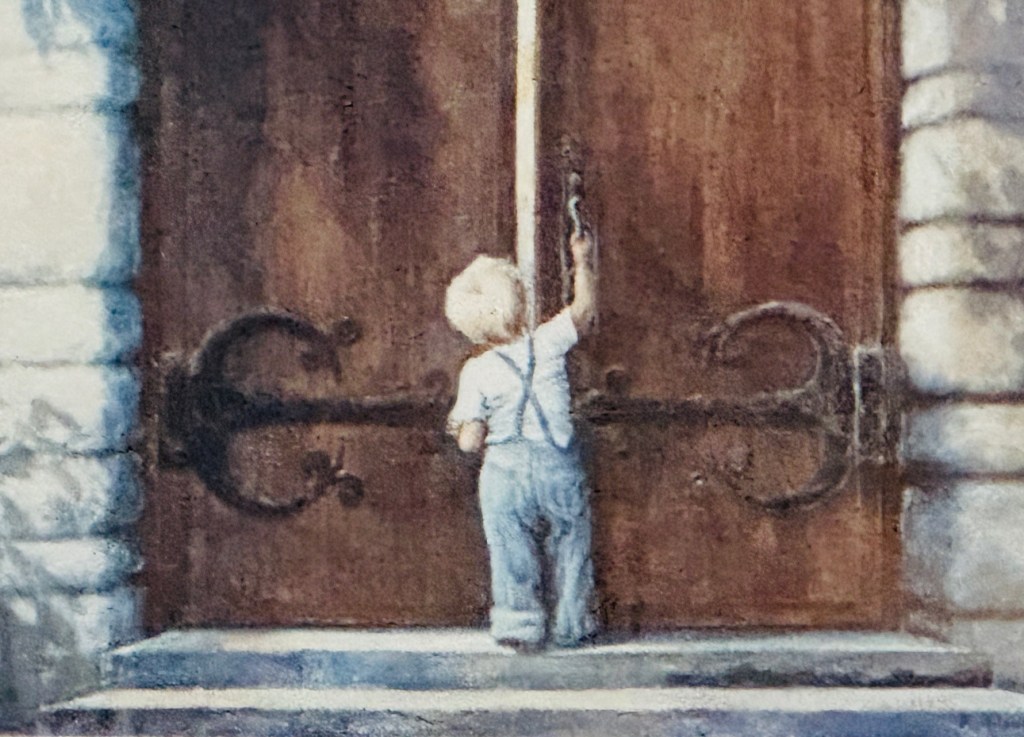
Randy Klassen’s painting “To Such Belongs the Kingdom of God”
A painter with words, an artist with paint, The Reverend Randy Klassen brought truth to life.
He transformed an easel into a pulpit by dipping his brush into the colors of God’s grace.
In the process, he conveyed the beauty of the Father’s love for which His children instinctively hope.
Randy’s “Child at the Church Door” has hung above my desk for forty years. It captured my sense of wonder when, as a young pastor, I stood at the threshold of mystery Sunday after Sunday where earth and Heaven meet.
That child was me. Opening that door was my sacred honor. The image bearer who reminded me of my call was my friend Randy.
Viking Leif Erikson scans the Seattle waterfront in search of an approaching storm
Whether the weather is cold or it’s warm, whether there’s sunshine or threats of a storm, whether dark clouds or blue skies are the norm, weather cannot be our god.
Whether you’re living with hope or with fear, whether your vision is blurry or clear, whether your kids prompt a smile or a tear, you cannot do life on your own.
Whether your passion is work or it’s play, whether the future seems sunny or gray, whether the world is all wrong or okay, you cannot but choose how you’ll live.
*This poem is based on a poem my Norwegian cousin Bjarne Birkeland shared with me in Norway in 2001.
“Whether the weather is cold or whether the weather is hot we’ll weather the weather whatever the weather whether we like it or not.”
I’m thinking of my Norwegian family today. After all, today is May 17th (Syttende Mai) Norwegian Constitution Day.



 My Rhymes and Reasons