Listening for the Baby’s Cry

On the 6th day of December many Christians around the world observed the Feast Day of St. Nicholas. As Bishop of Myra in ancient Turkey, Nicholas was a kind and generous man in the third century who became the patron saint of children and sailors. Nicholas’ legacy as a gift-giver gave rise to the legend of St. Nick (or Santa Claus) that continues to this day.

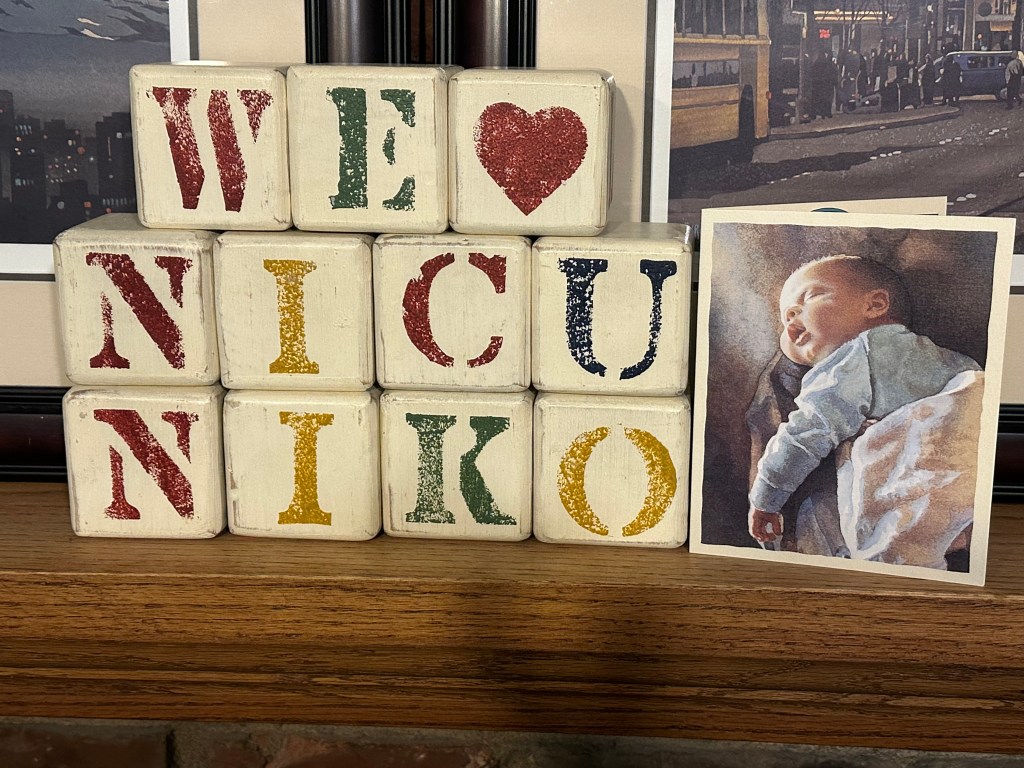
But on St. Nicholas Day this year, I found myself pondering another person with a similar name and a much smaller frame than the historical figure. The person who occupied my attention was a pint-size human born to my youngest daughter a month ago. In an homage to his Greek-American grandfather, they named him Niko Gregory Moore.

Truth be told, Niko’s birth was complicated. He arrived ten weeks early and tipped the scales at just under two pounds. He entered the world with serious issues a full-term baby would not typically have. In his first twenty-two days of life, our tiny saint underwent three significant surgeries. It’s been a tough beginning, but all the same, most days are good.

Words cannot adequately express how grateful we are for advancements in medical technology. In spite of the lengthy stay Niko will likely have at Seattle Children’s Hospital, this precious child of God has brought much joy to our world.

But like another infant boy born a very long time ago against the backdrop of challenging circumstances, Niko is surrounded by a host of those who love him. His family, his doctors and his nurses are his continuous cheer squad. This little angel sleeps in heavenly peace much of the time. And we pray for an abundance of silent nights (except for the hum of life-sustaining machines).  

There are no sounds of cattle lowing and donkeys braying at Niko’s “manger.” But there are sounds of computerized equipment and alarms that monitor his vitals and sustain his life. Cocooned in a cradle of wires, tubes, probes and miniature Pampers, our little Niko stretches his tiny feet and arms with rhythmic grace while his adoring parents and his grandparents look on. 

Like the awestruck shepherds who stood around the infant Jesus, we peek into Niko’s high-tech incubator with reverential awe and nervous optimism. We exercise our faith muscles embracing fear and uncertainty, complications and confusion as well as hopes and dreams. 

As you can see, this Christmas finds me connecting to the events of Christ’s nativity on a deeply personal level. A newborn beginning life in less-than-ideal circumstances makes for a natural comparison. And welcoming a baby into the family this time of the year ratchets the comparison up a notch. It’s as though I’ve been hearing the Baby’s cry from a hay-filled manger in Bethlehem. 

Ironically, because my grandson has been on a ventilator since his premature birth, I am still waiting to hear him cry. All the same, the situation we are living through allows me to relate to the ancient Christmas story with clarity. In the midst of our anxious and joyful days, I am reminded of Immanuel (God-with-us). There are ongoing whispers that God is with us.

But I’m not the only one who can hear Immanuel’s cry. So can you. The familiar message, music and traditions of the season intersect with where you live. There is every reason to believe that Immanuel is attempting to get your attention. 

But hearing the cry from the manger requires slowing down and shutting up. The ancient Hebrew poet was right. It takes being still to know that God is in the room. As you take time to reflect on the Biblical account of Jesus’ birth, dust for Divine fingerprints. Allow the references to the supernatural in the Biblical texts to encourage you in the circumstances that find you anxious, fearful or hopeless.

The birth of my daughter’s son finds our family drawing closer to God. And in the mystery of it all, we are drawn closer to each other. As you listen for the Baby’s cry this season, I pray the same for you. After all, that is what the birth of Jesus was intended to do!

Arbor Day: The Rest of the Story

The Morton Arboretum in Lisle, Illinois celebrates Arbor Day year-round

Johnny Cash used to sing about “A Boy Named Sue,” but one of Chicagoland’s most celebrated citizens was a boy named Joy. But who would name their son Joy? A man named Julius. A pioneer in the world of nature conservation, Julius established Arbor Day 150 years ago this month.

Julius, a young newspaper reporter in Michigan, followed opportunity’s call and became Nebraska’s territorial governor more than a century ago. When he and his wife, Carrie, settled in Nebraska City, they were dismayed by the treeless prairie. He’d grown up near trees and forests, and his merchant father had fostered an appreciation for God’s creation.

When the couple built a four-room home on their 160 acres, they started planting trees like they’d had in Michigan. They added shade trees, shrubs and flowers. Within a few years, they added an apple orchard of 300 trees, then another orchard of 1,000. Julius wasn’t content to keep this love of trees to himself. In 1872, he suggested Nebraskans set aside a day to honor the earth and plant a tree. More than a million trees were planted in the windswept prairie that April day. Within a decade, the day became a national observance known as Arbor Day. The April date was chosen to honor Julius’ birthday.

Now for the rest of the story…

Julius, whose middle name was Sterling, had a last name, too – Morton. Besides originating Arbor Day, he became President Grover Cleveland’s Secretary of agriculture. He was an original environmental advocate. It stands to reason his family motto was “Plant trees!” When Carrie presented Julius with his first son, he named the boy Joy. Though it was an unusual name, it was a way of honoring his wife. Joy was Carrie’s middle name. I’m inclined to think there was more to it. What better name might a man give the new growth of his family tree?

Unashamed of his name, Joy Morton grew up and moved near Chicago. There, he proved he was worth his salt. Literally! He became a successful and well-seasoned businessman. Joy Morton, you see, was the founder of the Morton Salt Company. He eventually made millions. But establishing a nature conservatory on his suburban Chicago estate (in Lisle) allowed him to leave his legacy. Creating the Morton Arboretum in 1922, Joy found a tangible way to perpetuate the family motto his father had instilled. It’s one of our most valued treasures and one of DuPage county’s most visited tourist spots.

Nearly 500,000 visitors explore the arboretum each year. That’s a lot of nature lovers, but  having lived in DuPage County for more than a decade before moving to Mercer Island, I think I know why they visit. The Morton Arboretum (like the arboretums in Greater Seattle) is the mortar of the community where busy lives and families find a common bond of peace every season.

In a frantic age, it’s a summer sanctuary of serenity where time ticks at a slower, saner pace. It’s a place of grace, where towering trees acknowledge their Creator as they bend and bow in the breeze and bid us to follow their lead. It’s a fall paradise of kaleidoscopic color where parking lots are limited so dying leaves can be given their much-due respect. It’s a winter wonderland of light where frozen trees spread naked limbs against a cloudless sky and dance before a setting sun in silhouetted majesty. It’s a spring garden of flowering shrubs that blush with beauty as nature lovers admire what they see and watch the Easter miracle re-enacted as death gives way to life.

The Morton Arboretum is an Eden-like setting in a less-than- perfect world where, amid the sorrow and heartache of life, Joy will always live on. Underlying the story of our arboretum’s ancestry is a simple, but profound, reminder.

Joy Morton’s expansive garden of trees, at Route 53 and the Interstate 88, bears witness that the core values that parents embrace need not die with them. The natural and supernatural realities we cherish can be passed to our children. Love for God and what He has created can be instilled in those who grow in our shade. The arboretum is a memorial to the joy of Mother Nature that Joy Morton’s father bequeathed him. It will silently preach “sermons” extolling the good earth for a good long time to come.

Next time you’re in the Windy City, why not plan a day trip a half hour west of Lake Michigan to explore the legacy of Julius and his son Joy?


Greg’s book,
Sheltering Grace
is listed on the
BOOKS menu
at $15.00 from
Lulu Books.