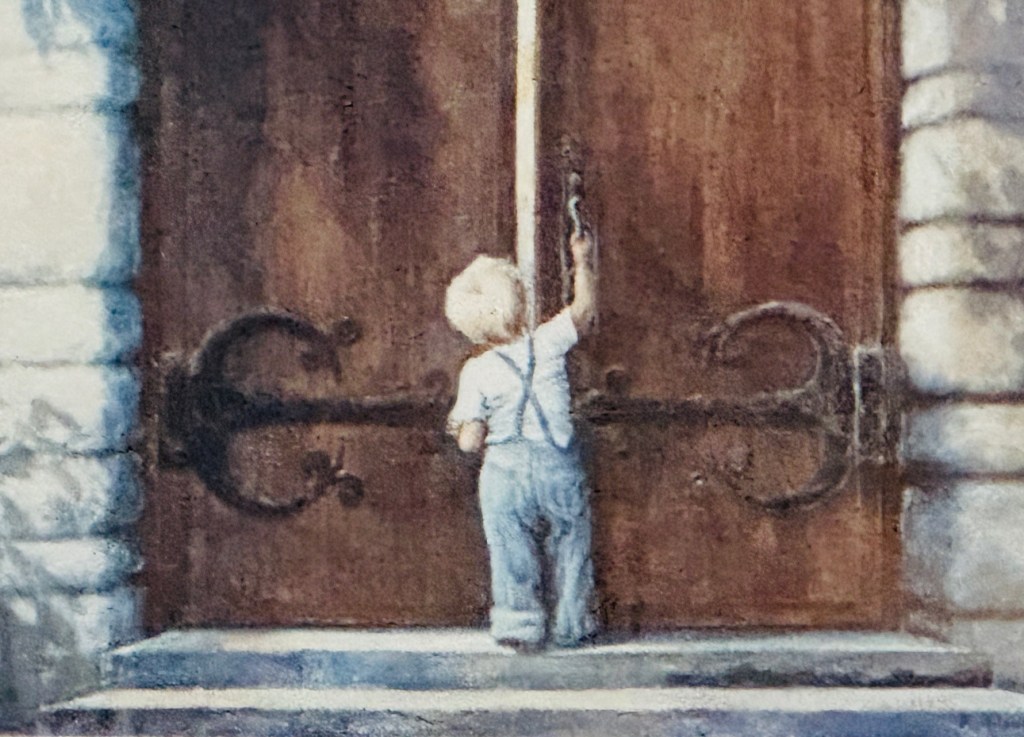
Randy Klassen’s painting “To Such Belongs the Kingdom of God”
A painter with words, an artist with paint, The Reverend Randy Klassen brought truth to life.
He transformed an easel into a pulpit by dipping his brush into the colors of God’s grace.
In the process, he conveyed the beauty of the Father’s love for which His children instinctively hope.
Randy’s “Child at the Church Door” has hung above my desk for forty years. It captured my sense of wonder when, as a young pastor, I stood at the threshold of mystery Sunday after Sunday where earth and Heaven meet.
That child was me. Opening that door was my sacred honor. The image bearer who reminded me of my call was my friend Randy.
The Wounded Lion Monument is one of the most popular attractions in Lucerne, Switzerland
This weekend Orthodox Christians around the world are celebrating the resurrection of Jesus. Because the Orthodox Church bases its observance of Easter on the ancient Julian calendar (in contrast to the Gregorian calendar followed by Western Christians), the most holy day of Christendom is celebrated on different days. Typically, the two Easters are a week apart. This year there is more than a month separating the two observances.
As a Protestant pastor with Greek ancestral roots, I have historically celebrated both the traditional Easter with my congregations and the Orthodox Easter with my family. When I was a young boy, my dad taught me the Greek Easter greeting. And to this day our family greets one another with “Christos anesti! Alithos anesti!”
This year finds me celebrating both Western and Orthodox Easter in Lucerne, Switzerland. And for both occasions there is the perfect spot in town at which to sit and contemplate the cornerstone of the Christian faith.
If you have ever visited Lucerne, you likely have stopped at the Wounded Lion Monument. This amazing rock sculpture, designed by famed Danish artist Bertel Thorvaldsen, commemorates the 760 members of the Swiss Guard who lost their lives protecting the King of France during the French Revolution in 1792. The monumental effort to carve the gigantic lion in the side of a sandstone cliff began in 1819 and was completed two years later.
The lion, who measures 20 feet high and is 33 feet long, lies with a broken spear in his back and his head bowed. He is obviously dying. Mark Twain called it “the most moving and mournful piece of stone in the world.”
I first saw the Lucerne Lion in-person six weeks ago while approaching Holy Week. As I stared at the beautiful (yet haunting) work of art, I couldn’t help but think of the Christ-like figure in the first of C. S. Lewis’ Chronicles of Narnia.
In “The Lion, the Witch and the Wardrobe,” the first of Lewis’ chronicles, Aslan the lion willingly lays down his life to lift the curse that has held the Kingdom of Narnia captive. The lion’s lifeless body lies cold and still on a giant stone table.
Using his palette of language, C. S. Lewis paints an unforgettable picture that conjures up the events of Good Friday. This gifted wordsmith conveys the suffering that provides the backdrop for the glorious message of the resurrection.
In his book as the symbolic story unfolds, Lewis pictures Easter Sunday as well. The stone table is discovered by the children without any sign of Aslan. They soon encounter the lion fully alive. Aslan has returned from the dead. The children also realize that Narnia has returned to its original glory.
The land that had been labeled “as always winter but never Christmas” was once again blooming in springtime glory. The visible and invisible evidence of Immanuel (God-with-us) provided Narnia with proof of a redeemed kingdom.
Although I have long believed that the truth of Easter is an ongoing reality and not simply a single day on the liturgical calendar, this year it is all the more in focus. With the two Easter observances of the Christian Church being more than a month apart, there is cause to contemplate the fact the resurrection can be celebrated continuously.
If you’re like me, hardly a week goes by without learning of someone you know (or know of) who has passed away. Death dominates the landscape of our lives. The shadow of sorrow creeps across our hopes and dreams. Grief is an ever-present reality. Parents die. Spouses receive a terminal diagnosis. Siblings leave us prematurely. Even our children are not exempt.
And given the grim reality of the Grim Reaper’s unsolicited visits to our families, knowing that death has been defeated once and for all is something I can’t celebrate enough. Having two Easters is just fine. In fact, I would welcome even a few more. Christ is risen! He is risen indeed!
This original chalk image by Warner Sallman was drawn in 1963 for a church in Portage, Indiana
Have you noticed? As Easter draws near sacred art is circulating on social media. One particular image that caught my eye was a painting by an artist friend in the Denver area.
Rose Edin, an incredibly gifted watercolor artist in her eighties, was commissioned by her church to paint the crucifixion. When I saw Rose’s latest contribution to the world of religious art, I communicated my appreciation. As a chaplain at a senior adult retirement community, I continue to amazed at the abilities exhibited among an aging population.
But there is another iconic piece of art that is guiding my personal meditation as the Lenten season draws to a close. It is an original chalk drawing by Warner Sallman (based on his 1940 oil painting titled “Head of Christ”) that hangs in the skilled nursing wing of The Shroes.
The framed chalk drawing on newsprint sketched by Sallman was created in 1963 before a live Sunday evening audience at the Portage Covenant Church in Portage, Indiana. When the Indiana congregation closed down several years ago, it was given to a friend of mine who works at our denomination’s headquarters in Chicago.
When Rob Hall learned that I had a personal interest in the life of Warner Sallman, and had appreciated his work since I was a small boy, it was gifted to our campus. Since then it has graced our care facility as a year-round reminder of the fact that we are a faith-based community.
One hundred years ago, Warner Sallman, a Chicago illustrator, was hired as the art director for a new monthly periodical called “The Covenant Companion.” A few months later he created a charcoal sketch for the February 1924 cover of the magazine. He titled his cover art “Son of Man.”
In 1940 Sallman used his original concept to create an oil painting which became known as “Sallman’s Head of Christ.” To date that painting has been reproduced over half a billion times and is considered the most reprinted image of all times.
After retiring from his career as an illustrator, Sallman, a member of Edgewater Covenant Church in Chicago, became a popular guest speaker at churches and Bible camps. On such occsions, he would draw a chalk version of his famous painting in an hour before an in-person group.
Last Sunday in our morning worship service at The Shores, we celebrated the sixtieth anniversary of the framed chalk drawing. For many of our residents who have recently moved to the campus or who have not had opportunity during COVID to frequent the Health Center, it was the first time the orginal art was seen. I shared the history of Sallman’s various versions of his image of the first century carpenter-apprentice turned rabbi.
As part of my remarks I told the congregation that my daughter and son-in-law (while studing at North Park Seminary in Chicago) lived five houses from the Sallman home where Mr. Sallman painted his famous “Head” in 1940. Several years ago on a trip to visit my kids, the current owner of the Sallman home gave me a tour of the upstairs bedroom where history was made eight decades ago.
As part of my research of Warner Sallman’s life, I discovered something rather curious. Mr. Sallman’s brother-in-law Haddon Sundblom, another Chicago illustrator, became equally as popular as the Head of Christ artist.
It was Sundblom’s image of Santa Claus that he created for Coca-Cola in the 1930s that has largely influenced how the jolly elf is represented to this day. One brother-in-law’s career is defined by his image of Jesus. The other’s is defined by his image of Santa Claus.
For photos of the other illustrations mentioned in this article click on the following link…


 My Rhymes and Reasons