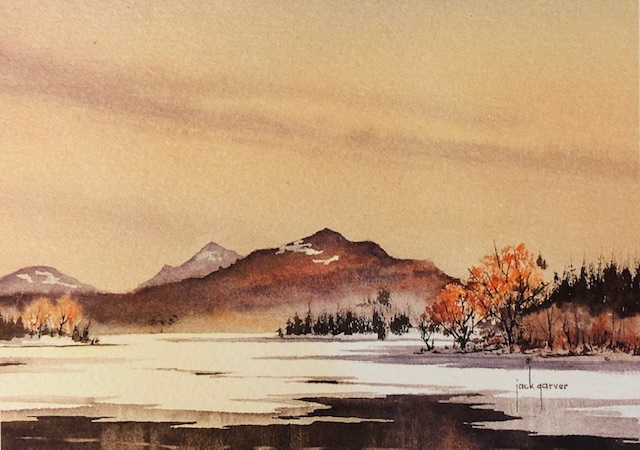
A watercolor painting of a typical drab autumn afternoon
The landscape of Thanksgiving is a picture of God’s faithfulness painted from the palette of our imperfect situations.
Like those times we feel stretched like a canvas, have a brush with disaster, are the victim of a stroke of misfortune, or feel unjustly framed.
At such times in spite of how we may feel, the Master Artist is still at his easel.
Much to our amazement, He uses paints we don’t really care for to portray His grace against the backdrop of His glory.
Amid the blustery winds and gray slush of our wintry world of woes, the Creator colors our lives with the brilliance of His steadfast love and daily mercies.
Great is His faithfulness!
In addition to each week’s post on this website, Greg Asimakoupoulos offers daily video devotionals on his YouTube channel. Here is a sample video. If you are interested in receiving these devotionals Monday through Friday, you can subscribe on Greg’s channel.
Have you noticed that eggs are in the news? And that’s no yoke!
We need them for breakfast, for cookies and cakes. Without them a souffle won’t rise. We need them for ice cream and Mandarin soup. Their worth is not based on their size.
Yet without them, we face an egg-ceptional crisis. We hoped the temporary shortage would be over-easy. But this hard-boiled dilemma isn’t going away quickly. Feeling fried trying to find solutions, we are scrambling for available cartons. We beat it to our local grocery store when what we’ve come to count on is in short supply. We long for a return to normal. In the meantime, we find ourselves willing to poach another’s reserves.
In times like these, envy stalks our contentment. And when we claim otherwise, we are caught in an omelet of our own making with egg all over our face.
Guilty as charged, Lord. When what we rely on for convenience isn’t readily available, we tend to fixate on what others have instead of being grateful for what is already ours. Teach us to be sunny-side-up blessing counters. Use this current situation to hatch a spirit of gratitude within us.
In addition to each week’s post on this website, Greg Asimakoupoulos offers daily video devotionals on his YouTube channel. Here is a sample video. If you are interested in receiving these devotionals Monday through Friday, you can subscribe on Greg’s channel.
One of the most popular Thanksgiving hymns is Come Ye Thankful People Come
“Over the river and through the woods to grandmother’s house we go…”
That timeless children’s song celebrates Lydia Maria Child’s childhood memories of visiting her grandfather’s house. Curiously, the original version refers to grandfather’s house (not grandmother’s).
Although the Christmas season is replete with carols and holiday songs, “Over the River” was the only Thanksgiving song I remember singing in school. Fortunately, there were songs that we sang in church that compensated for what was lacking in the classroom.
I love Thanksgiving hymns like “Come We Thankful People Come,” “We Gather Together to Ask the Lord’s Blessing” and “For the Beauty of the Earth.” There is just something about the lyrics to songs like “Now Thank We All Our God” and “All Creatures of Our God and King” that tune our hearts to sing God’s praise.
For me Thanksgiving is defined by feasting on turkey and all the trimmings including Gulliver’s creamed corn (a traditional family favorite) and my wife’s homemade pumpkin pie. It also includes the sharing of personal expressions of gratitude around the table before enjoying football.
All the same no Thanksgiving would be complete without borrowing language from folks like Martin Rinkart, Folliott Pierpoint, Fanny Crosby, Johnson Oatman and St. Francis of Assisi in order to voice my gratitude to God. The hymns of thanks we sing in church on the Sunday not only call us to worship, they remind us what Thanksgiving is all about.
Forty-five years ago, when I became a pastor in a denomination with Scandinavian roots, I discovered a Thanksgiving hymn I’d not sung in my youth. The melody was quite enchanting, but the words were what captured my heart. They were refreshingly candid. They spoke of pain and problems in the midst of a life of filled with blessings. Rather than ignoring hardship and heartache, the poet acknowledge suffering as part of the human experience.
Two of the stanzas read as follows…
Thanks for prayers that Thou hast answered. Thanks for what Thou dost deny! Thanks for storms that I have weathered. Thanks for all Thou dost supply! Thanks for pain, and thanks for pleasure. Thanks for comfort in despair! Thanks for grace that none can measure. Thanks for love beyond compare!
Thanks for roses by the wayside. Thanks for thorns their stems contain! Thanks for home and thanks for fireside. Thanks for hope, that sweet refrain! Thanks for joy and thanks for sorrow. Thanks for heav’nly peace with Thee! Thanks for hope in the tomorrow. Thanks through all eternity!
Upon doing a little research I learned that “Thanks to God for My Redeemer” (“Tack O Gud”) was originally published in Swedish in 1891. It was written by August Storm, a member of the Stockholm Salvation Army.
In addition, I discovered there was a logical reason why the poet referenced life’s setbacks and disappointments in his hymn of thanksgiving. August Storm’s life, like his name suggests, was beset by the unexpected and undesired just like a late summer deluge. Tragically, he suffered a serious back injury that left him crippled for much of his adulthood. Having experienced suffering and pain as a person of faith, he incorporated these realities in his hymn text.
The hymn was introduced to the American church through Swedish immigrants settled in the States near the turn of the twentieth century. As they experienced the hardships of adjusting to a new country, they clung to songs of their faith and heritage. Especially words that recognized problems as part of the faith journey.
As I come to this Thanksgiving week, I find myself counting my blessings. I am grateful for hymns that help me vocalize my gratitude to God for His goodness. But I am also grateful for challenges life deals me that help me see the faithfulness of God more clearly. And with that in mind, I’m grateful for the words written a long time ago by a man I never met.
In addition to each week’s post on this website, Greg Asimakoupoulos offers daily video devotionals on his YouTube channel. Here is a sample video. If you are interested in receiving these devotionals Monday through Friday, you can subscribe on Greg’s channel.
Deposits in the “Bank of Thanks” compound more than we think. The interest paid on gratitude astounds. So counting blessings is worthwhile and giving God the praise. That’s how we prove God’s faithfulness abounds.
Acknowledging how blessed we are assumes humility. For we are not deserving of God’s grace. Our gratitude is based upon a “wealth” we have not earned and recognizing what we’re called to face.
Confessing wrongs that mark our past, we seek to do what’s right by tearing down old walls that can divide. We build new bridges that connect our isolated lives and feast with friends (both old and new) while swallowing our pride.
When a friend turned fifty sometime back, I wrote this humorous rhyme:
You’ve reached the age where once again you play at hide and seek. Your playmates aren’t the kids next door, but facts you try to speak. So much of what you once recalled gets stuck inside your mind. Like popcorn hulls between your teeth, some thought get caught you find. But gratefully it’s just a stage. It’s not a total loss. You’ll do just fine if you can find a string of mental floss.
But truth be told loss of memory is no laughing matter. In my ten years as a chaplain at a retirement community, I observed the downside of aging. Growing older comes with the inevitable losses associated with the increased number of candles on our birthday cake. There is the loss of energy. There is the loss of strength and dexterity. There is the loss of hearing. Sadly, there can be the loss of a mate. And, too often, there can also be the loss of memory.
In addition to shepherding individuals in our memory care facility during the final months of their lives, I experienced the challenges of memory loss on a personal level. I watched my own mother navigate the confusing maze of Alzheimer’s Disease over the course of a decade. Gratefully, my little mom never lost her ability to express love to her family or acknowledge her gratitude to God. And she never forgot how to play the piano. She was playing hymns on the baby grand in her care facility up until a couple weeks before she died.
Dementia is an unkind companion of too many people we love. The cost it exacts far exceeds what families pay out for residential care. And yet I’ve come to see that it’s not just the elderly who exhibit memory loss. As a man of the cloth, I have witnessed in my forty-five years of ministry the frequency with which people of faith forget the faithfulness of God. I call it spiritual dementia.
Spiritual dementia is the tendency we have as humans to lose sight of times in our lives when prayers have been answered. We tend to forget how God’s presence sustained us in the midst of heartache or hardship. Having learned lessons of trust through trials and challenges, it is so easy to lose sight of how God came through in the past. The Old Testament is filled with examples of the Children of Israel not remembering what they had once known. And the tendency of God’s people to forget milestones of deliverance and provisions resulted in a lack of gratitude and an abundance of problems.
Remembering is the key. Long before my mom dealt with the demons of memory loss, she taught my brother and me the correlation between memory and gratitude. As little boys we heard our mom repeatedly remind us to “remember to say thanks” whenever we were invited to family friends for dinner. But her reminder to polite extends far beyond having good manners. “Remember to say thanks” is the two-step dance that enables us to recognize just how wealthy we really are. Being grateful is the by-product of looking back at our blessings. No wonder I have never forgotten my mom’s refrain. As this season of Thanksgiving approaches, I find myself focused on the importance of remembering. In our family we take time between the main meal and dessert to go around the table and verbalize those things for which we are thankful. Generalities are not permitted. Specifics are what is expected. And specifics are not all that hard to come up with if time has been spent reflecting on the goodness of God over the past year.
The author of Psalm 107 knows the correlation between memory and gratitude. Note how he begins his instructions: “Give thanks to the Lord, for he is good; his love endures forever. Let the redeemed of the Lord tell their stories…”
So what’s your story? Looking back and reviewing the goodness of the Lord will remind you that gratitude is not a mindless exercise. It takes focus and concentration. It takes remembering. Memory is the key!



 My Rhymes and Reasons